Episode Transcript
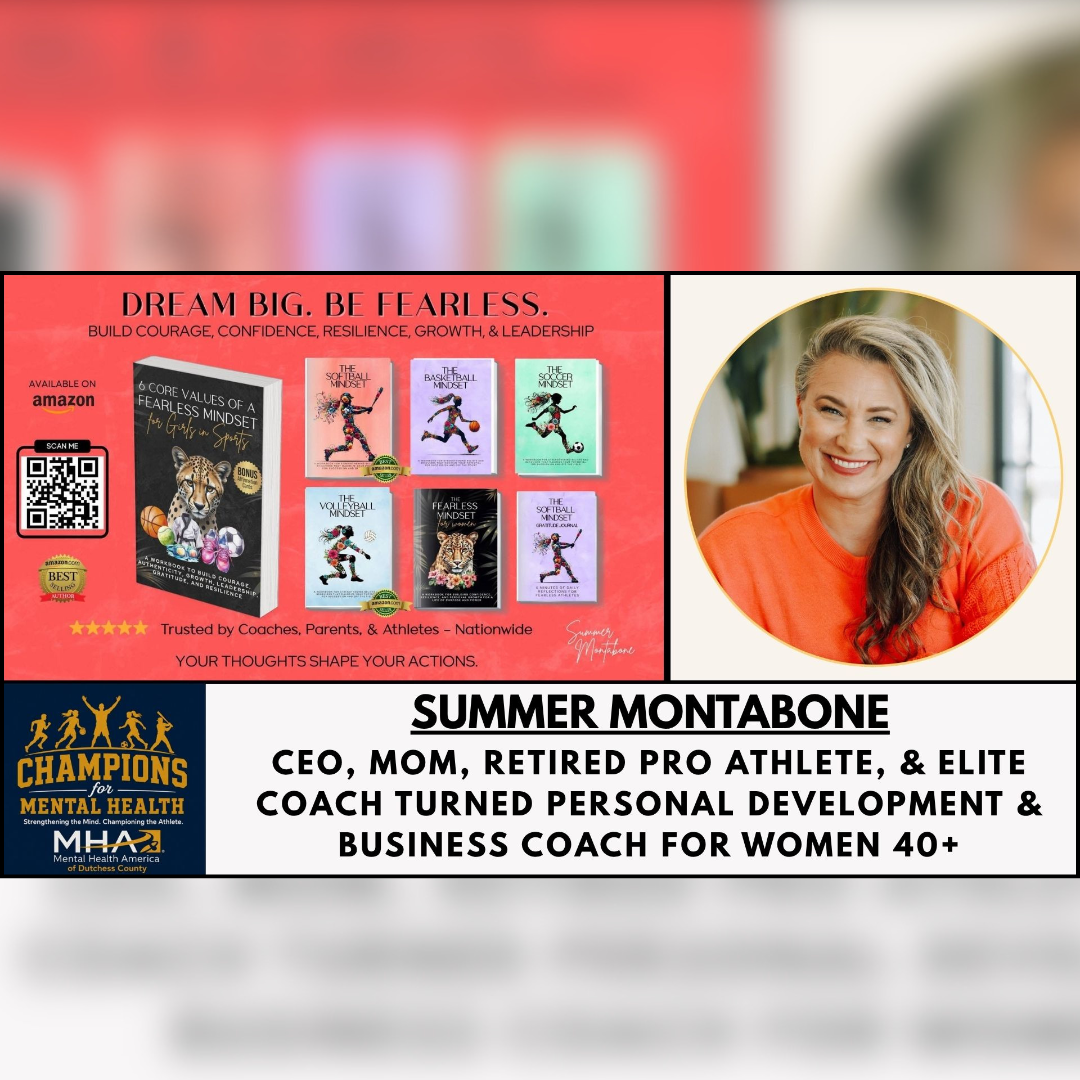
[00:00:03] Speaker A: Hey there, it's Connor Walsh, production and social media manager at MHA of Dutchess County. Before getting into multimedia production, I was a student athlete, just like a lot of you probably were or still are. In high school, I played soccer, lacrosse and basketball. And before that I played Little League baseball and I did karate. I loved playing sports when I was younger and it taught me a lot of valuable life lessons. It taught me resilience, work ethic, and how to be a good teammate. It had a great impact on how I identified myself and on how I managed my physical and mental health. This September, we're in. Introducing our latest segment on youn Best yout Called Champions for Mental Health. It's a segment on athletics and identity as we speak with local and professional athletes, coaches and trainers. On today's episode, we speak with Summer Montabone, CEO, mom, retired pro athlete and elite coach turned personal development and business coach for women over 40. We discussed summer's journey as a retired international fitness and Bodybuilding federation fitness pro. Going from national champion pro athlete and fitness model to business owner, author and mother, Summer discusses the lessons that she's learned from the different chapters of her life and how she's using that experience to help women become the best versions of themselves. Hey there and thank you very much for tuning in to your best. You Mental Health America's podcast on real conversations around mental wellness. Not just that. This is one of our Champions episodes, Champions in Mental Health, talking about, like, the athletic side of mental health and how we are establishing the identity that comes with it. And there's a lot that we're going to be getting into with the series and we're really grateful to have this guest with us today. She's a CEO, mom, retired pro athlete and elite coach turned personal development and business coach. She's had appearances in national fitness magazines like Women Magazine as a model and contributing expert. She is the author of the Mindset workbook series tackling a variety of different sports like soccer, basketball, softball and more. Plus more to come. So much more. We're really excited to be speaking with her today about her journey and what she does with her coaching. With us, we have Summer Montabone. Summer, how are you?
[00:02:00] Speaker B: Good. Thank you for having me here.
[00:02:02] Speaker A: Absolutely. It is so good to see you again. We were introduced through CJ Tomaskovic, who a big part of this Mental Health for Athletes initiative that we have here at mha. And I'm really glad that we're getting connected. We were saying before we officially got started, it felt like that first introduction was forever ago. But then here we are, and it's so nice to have this here now. But yeah, thank you for being here and thank you for being willing to tell your story. One of the things that we talked about when we met up the first time, you said that you don't want to just help women get trophies, but. But rather you want to make them total holistic champions. And that is a big mission to have. Before we really get into the nuts and bolts of your story, can you give like a brief overview of what your mission is with your workbooks and with your coaching?
[00:02:45] Speaker B: So I actually did start out like you said, like really with, with the women, having been a fitness business owner of 20 years. And after I sold my business to focus more on my children and my family, I saw there was a bigger gap and a bigger opportunity to start kind of that personal growth with the athletes. Right. Give them the framework so that they don't become women that are carrying that self doubt, carrying that baggage into womanhood. So that's kind of how, where I am today and how the, the workbooks came was from working with women, but now going, okay, let's go to the, to the core, right? The young, the young ladies, the preteens and teens.
[00:03:21] Speaker A: Absolutely. So when you were coming up, you were very active in the athletics community. If I remember correctly, you were D1 in college. You were a pro athlete in your own right, and then you got into the modeling and showing off your expert in these national magazines and all these editorials and then creating your own books. Let's talk about your athletic identity. What were the sports that captured young summer's heart and what was it that catapulted you on this athletic journey?
[00:03:46] Speaker B: So I think I just always had that kind of like natural athletic drive or that natural kind of competitive drive to prove myself because I kind of see it in my own kids. And that's one of the things I think parents will tell you. They start seeing a lot of more of their own identity in themselves once they start watching their kids in a variety of, you know, different capacities. So for me, like I played, you know, softball and then in high school, played volleyball, ran track. I actually was even the feature twirler for a couple years and then went on to college and ran track and I was part of the gymnastics club.
So, you know, I got a lot of different experiences from going through those levels. And I was always into coaching and like helping others.
And that became kind of a tagline with my fitness business later on was achieve your Personal best, recognizing that it looks different for everyone, too.
So that athletic background, obviously, the hard work, the dedication, really helped me later on when I transitioned to a business owner. So after college, though, I went into what's called fitness. And everybody wants to call it bodybuilding. Yes, there is a component to the physical fitness aspect, but I was looking for an outlet after college to continue challenging myself and, like, see what I was made of. And so there was, like, a fitness component. You were also judged on your physique. And I didn't have some of the, like, traditional traits that everyone would say, right, because I was very thin, very lean, hard to put on muscle. I wasn't a former gymnast, but I had done some right. And I was very tall. And so I actually won the tall championship, which was five, four and over, and I was five, eight. And so, you know, those types of physiques look a lot different. But the thing was that through that, and it took me a while to go back and recognize I was very deliberate in everything I did. Like, everything was structured, right, And I had a schedule and I followed it to a tee.
And I also went into my national championship with a mindset of, I've done everything I possibly could, so I'm happy with myself. And that's one of the things I think that a lot of young athletes struggle with now is they judge themselves on the outcome rather than the journey. And I even would ask some of my weight loss client, you know, and later on, as a personal trainer, are you willing to put in the work regardless of the outcome, you know, and learning a lot. So that whole experience, like I said, really taught me discipline, taught me the value of when you follow a plan to a table and you believe in yourself, you don't recognize it at the time because this was, you know, like I said, like 25, 30 years ago. So for me, luckily it worked out that day, but that was the mindset. And I kind of went in as a nobody, but because I was diligent, because I did everything and I had this internal, you know, I believe in myself. I'm happy with the work. It. So it didn't matter to me what happened. It just was a bonus that I. That I won.
[00:06:39] Speaker A: That's fantastic, though. You had the great. You had this fire burning in you for the competition, and you wanted to show something in yourself, and that's incredible when it comes to the fitness competition competitions that you were doing. You said that was about 25 years ago. What was positive back then, what was negative, and what have you seen change since then in the competition field.
[00:06:56] Speaker B: I'm really glad you asked that because for me, you know, I saw like, wow, you know, this hard work. And I did have some times obviously where emotionally I just felt like bottomed out. Right. Because in the athletic world, you know, typically it's for performance, right? To perform at your best, do you look fit? But like, we were criticized, scrutinized, right, for exactly how we looked. So you're trying to put physique and performance and like, nutritionally, like those don't typically go together for one. And actually years later, I was asked to present for the International Society of Sports Nutrition, kind of explaining, explaining those differences to coach, you know, because now we have so much more knowledge. Back then it was like just starting to come along. So kind of fast forward, I started coaching other athletes and things too. But after the birth of my first child, which is almost 15 years ago, I just really was over it. I was like, this is actually toxic. I don't want to be in this environment anymore. And at the time I was considered an iconic coach. I had a three time world Olympia, you know, Olympia champion that I had coached. And I was just like, this is not healthy for women, you know, and that's like you said earlier, I was like, I don't want to help women win trophies anymore. I want them to become their own personal champion. So when you say like mental health and mental fitness and maybe when you talk about that, sometimes those are a little bit different, right?
[00:08:15] Speaker A: Yeah.
[00:08:15] Speaker B: So back then there also wasn't social media like there was today. And I gotta say, I look at it and I say all the time, I don't think I would have been flaunting my body around on social media the way that I see some of these girls. And so the impact, right, of what we see today is influencing that constant judging yourself. Am I good enough? The comparing, right, because it's in your face all the time.
So, you know, there's a lot of differences. And I got out of that industry because I, it just no longer felt in my heart like I felt I was called to do other things. And because of what I went through after my first child with postpartum and some other things, I was like, you know, I need to be a voice for women that are suffering in silence. And so, you know, that's the path that I, that I went on. And you know, like I said today, now it's like, well, let, let's really help those girls lay the foundation with the girls so that when they become Women, they can, you know, that they have more of the skills to deal with those things that I felt like maybe I didn't. So I, I always say I went through all these hardships, you know, to be that voice and to help others and create frameworks, you know, so that they can face things stronger.
[00:09:25] Speaker A: Absolutely. I definitely want to get into your journey once you became a mom because that really kind of like catapulted you on the journey that you are now. But before we get there, I want to really hone in on what you were saying about the social media aspect of things today, but then also the competition aspect of things back then, the body positivity aspect of it all. You know, when you are being critiqued on your physique, not just for the performance, but for the physical look of it. As you were mentioning, do you feel like the body positivity movement in the fitness and bodybuilding competitions, do you feel like it's gotten better, worse or roughly the same, but just with new challenges.
[00:10:05] Speaker B: So for that industry, it's probably just new challenges. I think it's just kind of going in its own direction. And that's why really to me anymore, I don't necessarily consider that the health and fitness for the general population. Right. It's not health and fitness.
But I want to share an example when we're talking about this between athletes, right. And the body positivity. So like I was always someone that was like stick thin, right? Like I said, I was tall, I was lean, I was lanky. So like I always heard a lot of comments about your legs being so skinny and you're, you know, I mean, and like you can't be strong and all these types of things even in college. And again, people were just kind of working with what they knew at the time. I had a roommate that our coach wanted her to lose some weight. Well, what actually happened is she got slower and that's what I explained to people. Performance and sports and what you look like does not always coordinate. Could some athletes, could their body composition become better to help them excel as an athlete? Yes, but that's not always the case because now we're dealing with some girls in particular that are under fueled and they've done research to show that's attributing to higher. One of the factors of attributing to higher acl tears and girls. Right. So like girls in particular as an athlete or you know, fitness industry, you know, like I said, it's, it's a little different.
So if you're an Athlete, you know, you run track, you play softball, whatever you need to perform, you need to be fueled. And you can't worry about what some girls posted on social media do, you know what I mean? Like how she might look. Everybody's body structure is so different. We have to kind of accept that and see what can we do for our. That's why I said achieve your personal best. And so if you're competing in something athletic, where you need to perform well, you. You got to be fueled, right? And you can have, you know, you can have different body styles. Now in fitness industry or the physique industry, you are being looked at.
You know, can you see your abs? Can you see all these things that is not normal or natural or even healthy for some body types in both industries, women in particular, or girls might stop having their menstrual cycles because, right, their body fat's too low or maybe, again, they're not fueling them. So there's a variety of different reasons that can impact that. And that's not necessarily healthy for the long term. Just like I don't personally believe that marathons are healthy either, either. But people do, you know what I mean? So there's a different schools of thoughts to look at it and then make sure that you have, you know, all these factors dialed in to support your body for the long term. Health, right? What's going to be the impact later on?
[00:12:44] Speaker A: Absolutely. Now that begs me to ask, and feel free to not answer if you don't want to, but after your time competing, what kind of impact did that have on your body? Positively and negatively.
[00:12:58] Speaker B: So for any person, I would say, like, you cannot stay in that lean stage, right? And let's just look at this way. We've seen pro male athletes, right, that all of a sudden you're like, whoa, what happened? They just gained 20, 30, 40 pounds. And because you're participating at such a high level and maybe you have all this support, commitment, so what happens when you stop that you're going to gain weight. And most people, like I said, it's not just. It's not healthy and it's not possible, especially in that stage. Ready? And I will see social media influencers sometimes talking about, oh, here's what I really look, you know, the lighting. And I only looked good this one day. So we have to be aware of that. And so maybe there are some more positive things out that. But for me, you know, it was weird sometimes to look at myself and be like, wow, I look different, you know, and obviously now that I'M older and I'm 50 and my body is completely different. So you do have to kind of learn to, you know, accept where you are in the Season of Life as well, you know, and there's a difference. And I know for me, it was really like being healthy versus looking a certain way. Like, we have to, like, segment that. So hopefully that kind of answers the question.
[00:14:05] Speaker A: Absolutely. No, I appreciate that answer. I think that is very core to it because there are a lot of people who are chasing a certain look without thinking about what it's actually going to do to them. What you were also saying about certain athletes, when they stop doing what they're known for doing, and then people look at him, it's like, what happened to them? A recent example that I've seen, not so much on the gaining weight thing, but people think it's like, oh, my God, is this person sick? De Bautista, who was this famous wrestler for many, many years, and then he was transitioned into acting. He was draxed to destroyer in Marvel. He had to uphold a certain physique for that as well. But then when he felt like he didn't have to do that anymore and didn't want to do it anymore. Have you seen it recently? He's slimmed down a lot.
And people, the first reaction, they're saying, oh, my God, is he sick? Is he dying? Is. Does he have cancer? What's wrong? It was like he just didn't want to keep doing that, which was really putting a strain on him. It's like as. As you said, it's something that is hard to constantly manage.
[00:15:07] Speaker B: Yes.
Yeah. I mean, my whole life when I was in the physique industry, it was like your entire life revolved around the training, the eat, you know, I mean, it was like so precise. It was such a science to achieve a certain look, and you missed out on things. I mean, I remember going five. Five years of never having, like, cake or ice cream on my birthday, you know, I mean, because it wasn't part of the plan. Right. And I was people that I executed, you know, the plan. And so that's a. That's a great point. Like you said, though, too, about not just gaining weight, but losing muscle, because, yes, as we age, it's harder to keep some of that muscle. And like, you know, the rest, the recovery, the supplementation, whatever's happening, you know, that style of training. That style of training is hard on people's joints. When I shifted in my fitness business, too, I had some people that they were upset with me and I'm like, I cannot watch you beat your body up like that anymore. Like it's no longer healthy. How you're training. Right. The over exercising, the lifting way too. You know, I'm like, you're going to be crippled by the time you're 50 or 60. I. I can't stand by and watch this. So I guess that's good for him to recognize that was a season or a phase in his life and not necessarily his identity. And like you said, now other people have to, like, accept or look at him in this different light.
[00:16:25] Speaker A: Yeah, just certain, certain levels of training are unsustainable. And as you've mentioned, it's like different seasons in your life, different times in your life. What is sustainable, what works for you at a given time. And you got to look at the environment around you, what is happening in your life. And I think that's a really good transition to the next thing that I want to talk about. You brought up about what it was like when you had your daughter. You know, you mentioned that you had this postpartum depression along with it. I remember that we also talked about this previously. Around that time, your mom had died, and that left you with a lot of anxiety. And this was a very, very tough period in your life. I remember when we were talking with cj, one thing that you really wanted to hammer in, can you still be successful after a mental health scare that is so huge? And here at Mental Health America, you know, we see countless people who are at their lowest, and they can't envision ever coming back from that. But we've seen so many people do it time and time again. I know it's probably not an easy topic and an easy time to go back to, but is it okay to share some of that experience with us here today?
[00:17:28] Speaker B: Absolutely. Like I said, one of the things that got me through that time was going to. Why didn't every anyone ever tell me I could feel like this? And I've got to tell other people. I've got to be that voice for women suffering in silence. So, yes, especially here, I will be vulnerable. So you heard like, yeah, I've had all these accolades. I've been at the top of the world. I was a successful business owner, all the, all these great things. And yeah, my mom had actually died, you know, about six years before I had my daughter.
[00:17:54] Speaker A: Oh, okay.
[00:17:55] Speaker B: So it was like instantaneously when I was, you know, in labor giving birth. Like, I just started crying in labor and never stopped. It was like everything just happened from, like, Recognizing, oh, my gosh, I'm going through this without my, you know, mom. Obviously my husband was there, My mom's not here. I have all these feet. I mean, there was just. It just came on and it just literally never stopped. And then, you know, as a woman trying to also breastfeed, and that wasn't working, and my baby wasn't. My daughter wasn't sleeping. She still is difficult to this day. It was just so multifactorial between the grief of losing my mom, the hormones recognizing that, and then kind of finding out later, getting diagnosed ADHD at age 47, that how that all had an impact and why my postpartum was miserable. And, you know, I ended up in the psychiatric unit when my daughter was five weeks old.
And I'm the oldest of six kids. And even all my siblings were like, oh, my gosh, Summer is the strongest person I know. Right. I'm the oldest. Six kids. Six kids. I don't, you know, I mean, I can't believe it. And it was just like, I am very open about that because so many people are judged, right? Or those strong people don't, you know, receive help, or no one steps up to help them. And that was also part of it. They're just, you know, I don't blame anyone, but, like, there just wasn't enough support for me trying to still run a. Run. Run a business, breastfeed a kid, take care of the house, you know, take care of this baby that was constantly crying and I could never sleep. And I had a brain that. That sent. Sent me over the edge because I'll flip. Way back when I was in college, I actually had like six different sleep studies because I was always a long sleep. I was always a long sleeper. And they didn't know what, like. So anyway, this, like, just all blew up, right? Like, having my daughter blew up. And that's where a lot of the shift happened. Like I said, as far, like, professionally than even, you know what I mean, it just opened my eyes up to something completely different.
So, yeah, that was really, really a rock bottom time, like you, you said.
And I was able to, you know, come through working with doctors, working with counselors, because I'm the type person, too, is I wanted to be. Like, why? Why? Like, why? Wanted to find, you know, how do I help someone else not go through this.
[00:20:12] Speaker A: Yeah, I think the added context there, the fact that you were the oldest child of six, that's huge right there. I think a lot of eldest children will tell you is, like, a lot of pressure is put on the oldest. Sometimes you have to be the third parent at times when you have X amount of siblings, that can be a very tough thing to do. And when it comes to having a mental health scare of really any kind, and I know, I've been there, and I've been worried about being perceived as weak. And it's like, oh, my God, I've been strong for so long. I've been known as the strong one. I can't be seen as weak. Think about it, like, with fitness training, there are going to be some days where your muscles are so fatigued you can't do a bench press the way that you normally would. And it's like. And your muscles just give out. Does that mean that you're weak? No, that means that you're tired.
Same thing when it comes to your mind as well. When did you finally give yourself that grace and that realization of, I'm not weak, I'm just tired, I need a sec to regroup.
[00:21:13] Speaker B: So I'm not 100% sure exactly when that happened, but my husband and I, you know, were struggling for, like, three days, really, that we went to the doctor, we went to, like, nobody could help me. And finally he was like, we are going to the E. Like, we're going to the er and, you know, so I also reframed it. And reframe is a skill that I teach in all my workbooks that, no, I'm strong because I did that to help my family. And I think today it's different.
I feel like back then, a lot of people wanted to be like, oh, you're a mom. Just deal with it. Like, you can be sleep deprived, you know, that whole mindset. I think today we have a different narrative, you know, surrounding mom and mental health. And because I was like, yeah, no, I mean, I was in complete collapse. I actually had even, like, lost almost all my, you know, pregnancy weight. Like, I was in a bad state. But even the doctors, even the stack, like, nobody could help me. Nobody really knew what to do. So we went to the error. So I just really framed it as. And I. And I was there for an entire week. The doctors even were like, you need to be here because you need the rest. You need the breakaway. But I reframed it as. I was strong. I was strong for my family. I did what needed to be done for my family instead of, oh, my gosh, I can't believe you would leave, you know, your baby and blah, blah, blah. Because I think a long time ago, some people used to think that like postpartum depression stuff was you didn't like your baby, you know, I mean, or like it was completely misconstrued on what it was. So we know so much more now. And like I said, even today I've recognized new things about what triggered that volcanic eruption. And it wasn't just one thing. Right. It was multifactorial. Now the other one thing I want to say, because we're talking about this, of maternal mental health back then too. And I had seen a couple of different, you know, doctors, one in the hospital, whatever, one tried, one wanted to automatically label me bipolar. Oh, any mother who comes in is automatically bipolar. Well, that was an old school thought.
And so I now it's not, it's not that at all. But I had to be like, no. And luckily there was a nurse practitioner that was like, no. Like, she's like, no, you need to go somewhere else. She's like, no, you're not. But that was like their answer. Right? Because even psychiatrists, like back then and again this, I mean, 15 years ago really wasn't that long ago. No, they did not know what was happening, what to do, what to help. Right. And I don't know in your area, but in my area there's like no psychiatric units anymore. Like, yes, hardly any. So where do people even go for care when they're in crisis? So anyway, I'm sure that's a whole nother. Right.
You know, so it's like, luckily, you know, my husband recognized, you know, like June, I mean, and was there to be like, no, we need to go. And yeah. So I had to be on medication, you know, for a while to get me to a point. And sure, being in health and there's people, I would be like, you know, oh, I don't take medicine. Well, guess what, Some people have chemical imbalances. And if that's what helps you, where you need to be, you know. So anyway, so many different tangents, we
[00:24:17] Speaker A: could go so many places for sure.
[00:24:20] Speaker B: There's. It's like having a 5,000 piece puzzle though. Yeah. And trying to put it together and nothing's one size fits all. There's not necessarily one thing that you can pinpoint A lot of times it's, you know, multiple things. And like I referenced earlier, later on researching adhd, that was actually a huge thing I now see in addition to the grieving my mom, the hormones, that was how my brain reacted in that stressful situation as well. How multifactorial.
And I'm sure, I don't know if that ever comes up on your show about the number of women in particular, that once they're, like, kind of like perimenopausal, becoming diagnosed, you know, with different things that they had been masking in their entire life, too.
[00:25:03] Speaker A: It's interesting. No, that particular subject hasn't come up on this show specifically, but I've had other shows where I've produced, where we've talked about it. I think I was first introduced to that concept when I was producing the Vital Women podcast. We were talking about the. The population of women that have been diagnosed later in life, say, 40s, 50s, 60s, whatever that might be. And it's kind of like, oh, I guess that kind of explains a little bit, and then try and, like, kind of reframing, reworking and figuring out what that means to them as individuals. You also mentioned how, like, there's not as many, like, psychiatric facilities in and around the area. We have a very famous one around here, the Hudson Valley Psychiatric Facility. Facility that it's been shut down since the 90s, but the facility has been there, just left to rot for a long time. There were a couple of fires that just happened a couple of months ago.
Part of the land is now a shopping center.
Yeah.
[00:25:58] Speaker B: So you're right.
[00:25:58] Speaker A: It's like, where do people go? Fortunately, you know, a place like Mental Health America, we have all the different case managers, we have the different counselors. We can get you to the right places. But for a lot of people, it is like, yeah, where do I go? What do I do and how do I do this? With, like, unfortunately, there is still a stigma of it where it's like, am I weak for doing this? No, you're strong for doing this. Because if you kept going, you're going to lead to either burnout or something way, way worse. So that is strong to accept that help.
So with that, that, that difficult time period that you had and the fact that you accepted the help, it helped you with your health, it helps you with your family. Let's talk about how you're using that strength for that moment to now help others. You have your mindset workbooks, you have your coaching.
What lessons did you learn through those time periods that you are now putting into your written work and your oral work?
[00:26:56] Speaker B: So I really went on a deep dive. Not like, you know, it wasn't just with doctors and counselors, but even with, like, coaches and personal growth.
And so I went on a deep drive on that. And I recognized as both a mom and a business owner, everything is very male driven. Like, the Books are for my coat. Like, where's the women? Right. And I have a lot of different theories, or not theories, but thoughts on why that is. And a lot of that is because if we are moms, we truly do have a lot of different responsibilities. Even though certain people back then wanted to be like, you're using that as an expression excuse. I legit would have that said to me. And I'm like, you don't live my life. You don't know what I'm trying to juggle. Right. So I recognize that a lot of these concepts that were being taught by predominantly men didn't necessarily fit what women needed. So, like, I had started some different things within my own fitness facility, like a CEO moms program. And then I really kind of harnessed in on this, this fearless thing, like being, you know, fearless and coming out stronger, facing the fears. So I like, created a whole framework based on, like, everything that I did that I thought was helpful but also realistic, like what you said, of what fits in, especially for mom. So I did write a workbook that's called the Fearless Mindset for Women. And I share some of these different things. And I. A lot of self discovery, a lot of decision making. Right. Because a lot of women aren't using their voices, whatever it may be. And so I, I did write that workbook. But, you know, a few years ago, once I was really in seeing my girls and sports and having been a coach, like, my. My degree is in health and physical education. I actually started teaching baton lessons and helping in the weight room at 15 years old. Like, I've always been coaching and teaching, right. And like breaking things down. I always say, like, you have to start with addition and subtraction, multiplication and division. Right. You can't jump into calculus. Well, what I started noticing is coaches coaching my young girls in one learning style.
It's only auditory. We're only talking and me being confused, sometimes not even understand what they're saying. And then two expectations are not in alignment with development. So again, my background in health and physical education, I know what's developmentally appropriate for different skill levels. So not just the skill, but the mental aspect. Right. Sometimes my daughters even being like, every single person on my team was crazy crying. Well, my girls are not that type of emotional processor. So I also came up with like, these six different emotional processing styles that you might see in female athletes. Right. So anyway, I just saw, like, wow, there's all these gaps. We've got coaches that don't have the appropriate training. They don't have the appropriate support.
So, like, someone kind of planted a seed in my first workbook was the softball mindset. And so it's a whole framework of like, kind of like these five steps or core concepts that, yes, are very similar that I taught with women, but in a developmentally appropriate thing. So, you know, I started with that and it kind of caught on. And I think, you know, part of it, I got to put like, the girly, fun feel in it because that's another thing we want to take away half the time that kids are kids. I want this to be an experience for them. I want this to be fun. I want it to be about them and about them individually, you know, because I'll have a lot of people be like, why are there lines on your paper, on the page? There's not enough content.
And I'm like, we are overwhelmed with information. You don't need to keep telling girls more things. They need to learn to find their voice. They need a space to brainstorm. They need a space to process emotions. And I hate, hate to say, and I don't want you to think like, this is a man, whatever, but it's typically, it comes from men. And I'm like, this is part of the problem when we have men coaching and they're not understanding that it's not the same and. And not everyone's different. Like, like I said, my girls are completely stoic. They're not going to cry. I mean, my one is broken bones. She doesn't make a peep, right? You might have somebody else who's like, bawling, right? And it's just like, you treat those girls differently. But no, you need to recognize that's how they're processing their emotions and processing in their nervous system. And you need to teach those skills just like we're trying to teach them how to swing a bat, serve up whatever it is.
So I saw this huge gap that we're not teaching those mental fitness skills. That's what I call mental fitness.
That's a little different from mental health, right? But when you have this mental fitness structure, just like when you have a physical fitness structure, your mental health is going to be better. So my workbooks teach self assessment, even like goal setting, reframing, fork in the road thinking, because our brains are wired and girls are highly perfectionistic that the second semester we go negative, right? We go negative. It's bad. So I teach them how to shift those thoughts. Sorry. As you can see, now I'm getting really excited. So you just have to stop which is great.
[00:31:46] Speaker A: Which is great. I love the excitement.
[00:31:49] Speaker B: So. So, you know, I've come out with different sports now, you know, using language that girls can understand. And like I said, this one, it crossed over 10,000 copies sold, and I never imagined that would happen.
And the people that reach out to me, telling me how much it's helped. But of course, as we know, there'll always be that one negative person, right. That wants to criticize. And I'm always like, then you need it the most. You're not understanding what is developmentally appropriate. So I want to give you example. Sorry. And please do other questions. So, for example, in the back, in the back, there's some coloring pages with a story on the back.
[00:32:28] Speaker A: That's great.
[00:32:29] Speaker B: There'll be plenty of people that want to call that childish. And I'm like, have you looked at the adult coloring book industry? As like, right? So again, this is part of the problem. You want kids to mentally reset, but you're not giving them a space to do it. And coloring the pen. I always say the power of the pencil. And we talked about social media. We talked. We are not having kids take pencil to paper enough. And there's a psychological, physiological component, right, that retrains your nervous system. They come up with their own answers. Because like I said, every once in a while people are like, well, I'd like to see more content. I'm like, quit telling girls what to do. Let them figure it out. You know, that's a component we're missing with our youth and the decision making. They have to take ownership of their journey. So like I said, they're doing personal growth through sports. And they have no idea.
They have no idea. So that's why I'm like, I hope that these girls, through all these different workbooks, truly can become those confident women that aren't faking it. Because a lot of women are faking it. I've trained or done like executive coaching, like I said, with female high high ups who are like, I have imposter syndrome. They're like, I fake it. Like, I don't feel comfortable. So, you know, we have an opportunity to help them now do this. And we always say, oh, girls who play sports become women who lead. Great. That's a great quote. But what are you actually doing to teach them that? And so I'm like, I solved that problem. I've got it for all sports. I've got it for volley. You know what I mean? I solved that problem because you can put out all these fancy quotes and it Means nothing if you don't have the structure behind it.
[00:34:04] Speaker A: Absolutely, Absolutely. I'm very excited about these books. These books are great. And I love the coloring book aspect of it, of having these pages in order to do something. It's something physical. It is pen to paper. You are physically creating something. As somebody who is a digital creator, I love doing all the digital creation, but. But, God, do I love doing something physical when I get to, like, physically put something together. And I think it's so, so fun. Not just that, but the creative outlet that it brings, the creativity, the imagination. And hey, if somebody's saying is like, they want more content, just buy more books. You got more. Check out the rest. You got more in that. It's all good. Hey, if, honestly, if people are saying that they want more is like, hey, leave them wanting more. That's solid. Let's talk about the positive responses that you're getting from this. Are there specific stories or specific moments that people have reached out to you and says, like, wow, this has helped me because X, Y, Z, or this made me feel blank. Do you have any specific moments that you can share with us right now?
[00:35:07] Speaker B: Absolutely. And I just want to clarify that the response is extremely positive. Otherwise, I've sold 10,000. But as you know, with anything, the people with the negative opinions are more likely to express.
[00:35:20] Speaker A: My. My editor and I, we were just going over, like, a couple of comments that we got on TikTok and YouTube from a few of our videos. Majority, great. All looked great, but it was like the one or two. If from a very specific video, we're like.
And it weighed on us. But you're right, you know, we got to focus on the majority of the positive. 10,000 copies sold. That's incredible. Yes, please tell that story of the responses that you've gotten.
[00:35:45] Speaker B: Absolutely. So I will have coaches who have left reviews on the Amazon page or reached out to me and say that that workbook is now part of when someone joins their team or makes their team, that's the first gift they give. That's how much, you know, we love this workbook.
[00:36:00] Speaker A: That's an honor.
[00:36:01] Speaker B: Yeah. Like, I'm. And I just wish I could hear from even more people. Do you know what I mean? Like that. But I've gotten a lot of those. A lot of those. For example, the other day, I had a coach, you know, she reached out. She's like, I'm. I want to order 40 copies. I want every girl you know on my high school team to have this. So, yes, high school is using this framework. And that's why I just want to say too, a lot of times people want to skip steps and think of things are so hard. It must be better. And that's not true. If you don't have a foundation, you can't build on it.
One that really resonates with me a lot is I had a mom, like, I just happened to see it some. She posted in a group and she's like, I don't know who recommended this workbook, but thank you so much. She's like, my daughter almost changed her attitude overnight when she recognized it was her negative attitude holding her back. So to hear things like that, you're just always, like, blown away. And that's why I said, like, because of how many, you know, copies are being sold. I know that people are telling each other about it. I know they're reordering it for their team, you know, each year. And that's why I've expanded other pieces of it too, to support it. Right? So it's like that continuation because I'm a big, you know, addition and subtraction before trying to jump into calculus. So, yeah, tons and tons of success stories that way. And like I said, if you actually use it, it's going, you know, it's going to work. And like I said, I think it's more of a frustration if I have someone flip through it and they're like, why? Why is there only one question on this page? And it's like that there is more power in asking the right questions than having all the answers.
So that's a problem or a challenge, I should say, with some adults who only want to tell kids what to do and don't want to help them develop the skills to become a fearless decision maker. And that's something I talk about in some of my things, too. You have to make your own decisions, and that's building confidence, right? Or we just want to tell girls, be confident. And I'm always like, well, what does that mean? Yeah, what does that mean? Be confident. What does it look like? So, like, this book really takes them through, figuring that out through some different core values. And I don't sit there and talk about confidence, right? We talk about what are the different values that, you know, develop you as a person. So, like I said, I.
I'm blown away. I'm so thankful. I just had a.
A call with another author the other day, and he was just like, you know, you really were called to do something. You know what I mean? Like, and so that is like, thank you. Because as we talked about before, too, a lot of times, we don't want to give ourselves enough credit. You know what I mean? Do the same things. And like I said, as a mindset coach, my brain still goes that way sometimes. Well, I could do more and I could do better. And it's like, wait a minute. We have to learn to pause for a second and recognize what is good. Right? And we don't. We don't stop and smell the roses enough. And that's a concept that I introduce in the workbooks and then I have as part of a daily journal where like every day you're like, well, what was the best thing you did today? Right. And I had my 11 year old help me write one set of the questions.
[00:39:05] Speaker A: Oh, that's so nice.
[00:39:06] Speaker B: Yeah. You know what I mean? Because I wanted. This is for the girl, right? This is for the girls. It's just so many adults want to point fingers to kids these days and it's like, no, you what? It's like, you know, for these kids. And so anyway, I'm so happy to give them something that's a tool that truly will impact them for the rest of their life.
[00:39:26] Speaker A: Summer, it's so beautiful. I love the work that you're doing with these workbooks. And a number of things that you just said there, that feeling of could I be doing more? That's something that can transcend any kind of industry, any kind of person. And I saw a quote recently and it's. I think about it every time where I feel like I should be doing more, I should be doing more. Just because you think you, you could be doing more doesn't mean that you're not doing enough.
And that's so huge. And in regard, taking that lesson and looking at the questions that you have in your book, the fact that you have this empty space that is a blank canvas that they are able to then make something for themselves. You said asking the right questions is way more powerful than giving the right answers. And that is, like, at the core foundation of philosophy. I love philosophy. I have Marcus Aurelius's Meditations right next to me. I got so much on my bookshelf. And you're right. As somebody who's an interviewer for the last 10 years, it's about asking the right questions. You don't want to give the answers because when you ask the right questions, that can lead to some kind of revelation that may not have been noticed before. And that is impressive. Summer, we're getting to the end of the hour of this episode. I just got to say thank you so, so much for everything that you shared here, from the vulnerability, the storytelling, the lessons and everything. Before we completely wrap up, though, what last little nugget would you like to share in regards to the work that you're doing and what you want to see happen in the athletics community, scholastically and professionally moving forward?
[00:40:55] Speaker B: Well, my. My big audacious goal is can I get one of my workbooks in my library in the hands of every single girl? Can I. Can I get that tool, you know, to them, to help. Help them build that foundation? Like I said, that's how we create more resilient women. That's how we create our future leaders. That's how we make an impact. So that's my. My big audacious goal. Sorry, now I feel like I already forgot what was the beginning.
[00:41:21] Speaker A: What last little nugget are you just looking to share on.
On the work that you're doing?
[00:41:26] Speaker B: Well, I guess this is a good example that even, you know, experienced people, we still forget things we still mess up, right? And I think a lot of times we forget that with kids, right? Like that kids are going to forget things. Kids are messed up. And it's all in how you handle it. And so that's what's through. My entire workbook series is teaching you how to handle it, how to move forward.
Being fearless doesn't mean you don't have any fear. It's moving forward despite of the fear.
So I guess that would kind of summarize the nugget. You know, I'm really passionate about that, especially for some of us, you know, like, like I said, at my age, like, some of us girls and women were kind of, like, told, be quiet, stay over here. Don't shine. Right? Like, and I want girls to be more authentic, own who they are, and kind of figure that out and just grow and blossom. And I'll stop right there because, like I said, I get too excited about.
[00:42:19] Speaker A: This is something to be excited about, Summer. This is great. And of course, more people can check out your stuff online. They can go to your website, they can order the workbooks, they can learn so much more. Where should people go in order to find more of your work?
[00:42:31] Speaker B: So if you want to just go straight to Amazon to order a workbook, you just type in my name, Summer Montbone, or the series is the Dream Big Be Fearless series. Make sure if you get the softball mindset, soccer mindset, volleyball mindset, basketball mindset, it's written by me.
My. My dream big Be Fearless series. And then I do have a page on my website, summermontal and. Com, that's a workbook page because I also have some digital toolkits that support some of the workbooks because I'm big on different learning styles and so, you know, you're reading and writing but some people want to see and hear. So I've also paired some videos with a couple too so that it helps all learning styles, especially, you know, individuals that might be neurodivergent like my myself, you know, that we want to hear things, feel things from different aspects. So yeah, summermontabone.com workbooks or you can find me on social media, Summer Montalone, because there is no other person with that name.
[00:43:29] Speaker A: There we go. One of a kind. We love it. So, so good. And of course we'll have all the links in the description of this episode so you can follow along, learn more, maybe order some books for yourself or your teams. Who knows? That would be fantastic. Summer, thank you so much for being here on this episode of youf Best you. We really appreciate you and thank you for being a champion for mental health.
[00:43:48] Speaker B: Thank you. I really appreciate it.